Flight Through Infinity - Chapter 9

New to the journey through the infinite void? Start here at Chapter 1
See the full Archive here
Nine
When the Nomad finally reopened his eyes, night had fallen across the primordial world. A thin scattering of cloud wisped overhead, drifting beneath the dusting of infinite stars. The Nomad leant forward in his seat, groggily rubbing his brow. For a brief instant, he had forgotten what had transpired, awaking in his cockpit on an unfamiliar world as he’d done countless times before. But as he gazed down, he saw the green tinge of algal residue caked across his EVA suit. Traumatic memories of lightning, of being dragged underwater, of suffocating, of fighting for his life, all came flooding suddenly back. His pulse quickened. He gasped for air. He thrashed in panic about the cockpit. After a moment of relived terror, he realised he had made it. Somehow, against all odds, he had managed to reach the refuge of the cockpit. The storm had passed. It was over.
He was weary, his body fatigued, his mind depleted. Almost drunkenly, he searched the cockpit for his helmet, finally recovering it from the floor. Locking it onto his EVA suit’s collar bearing, he depressurised the Fighter and opened the canopy.
Exhaustedly, the Nomad climbed out of the cockpit, down the ladder, and set foot on the sodden ground. With his head lowered in dread, he stumbled over towards the capstan winch to begin assessing the damage. It was as he had both feared and suspected. Lightning had struck the winch, splaying the machine into a scorched and molten mess. The capstan itself had been rent from the device. As the Nomad glanced around for it, he came to suspect it was now at the bottom of the lake, beside the filtration pump.
He’d been fortunate not to have a hand on the cable the moment the lightning struck. The loops on his harness where the carabiner attached were scorched, the partially molten fabric having just insulated the Nomad against the current surging through the metal. Were the harness not manufactured to their specifications, he may well have been killed outright by the lightning strike. But the fibres of the loop had held out, protecting the Nomad against the millions of volts conducted down the cable, driven by a current measuring into the tens of thousands of amperes.
The winch had not been so fortuitous. The thousand gigawatts of power, delivered in a minuscule fraction of a second, had ripped open the reinforced steel alloy housing the winch, frying the motor inside. The Nomad peered through the gouge in the casing; the majority of the internal components were charred and warped beyond recognition. The winch was unsalvageable.
The Nomad dropped to his knees, frustration compounding his lassitude. He felt something beneath his shins, partially buried in the mud: the power coupling. Slowly tracing the cable with his eyes as it meandered through the sludge, his heart sank in sickening horror. A terrible realisation cut through the stupor of the Nomad’s exhaustion. He had been so concerned by the loss of the winch, a relatively unsophisticated and potentially replaceable piece of equipment, that he had neglected to consider the vastly greater concern. The harness had indeed protected the Nomad from electrocution; had the current grounded through him, he would likely be dead. With the winch double insulated, the Nomad had until this point foolishly assumed that the majority of energy from the lightning bolt had grounded through the pump at the end of the winch cable. But now he realised that simply could not have been the case.
Electricity always took the path of least resistance. True, the metal winch cable was relatively conductive. But what was even more so, was the length of power cabling specifically designed to carry a current, connecting the winch directly to the Fighter; more specifically, to the Fighter’s power cells. That was what had happened to the energy of the lightning strike. It hadn’t been earthed at all! It had been conducted away, directly into the Fighter: tens of thousands of amperes in a mere fraction of a second. And the Nomad knew all too well what happened to batteries subjected to too great an incoming charge.
For a long moment, the Nomad dared not move. He dared not turn his head to look towards the Fighter out of fear of what he would see. He didn’t need to. He already knew what had happened. He was stranded on this planet. The Fighter’s power supply had been obliterated by the lightning strike. The Fighter was dead. And so too would he die here, marooned on this isolated primordial world.
But it couldn’t be true! He had opened and closed the canopy. He had depressurised and repressurised the cockpit. The Fighter was still somewhat operational, and therefore, the damage could not be absolute. The ship still had some life in it. It wasn’t dead yet. Even still, it might not ever take off again. He could still be marooned.
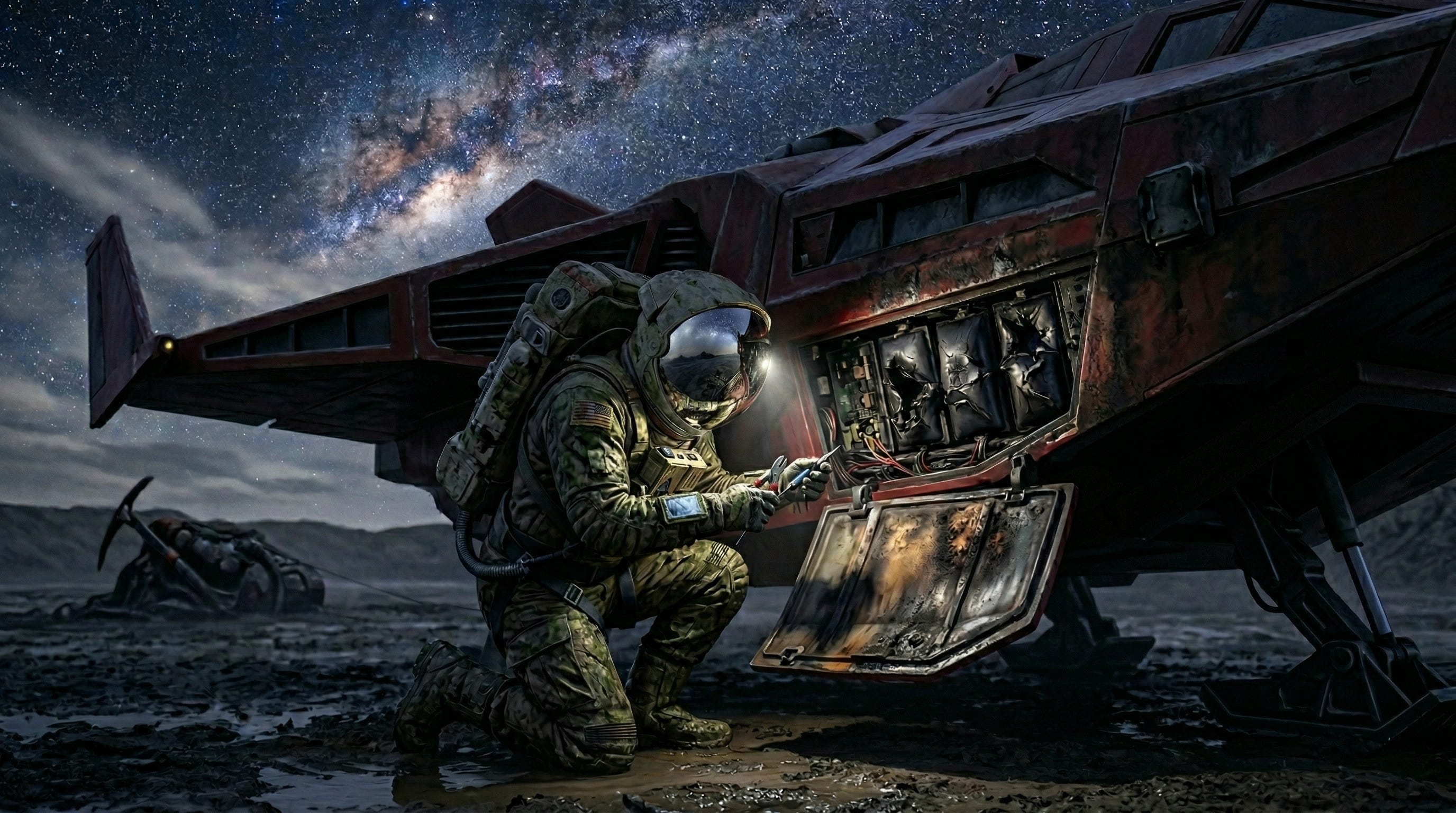
Terrified of what he was about to see, the Nomad steadily rose to his feet and began the arduous walk back towards the Fighter. He kept his eyeline low, following the snaking cable along the ground until it finally rose out of the mud, tracing upwards to the sockets on the undercarriage of the craft. Already, the Nomad could see the power cell access panel was hanging open on its hinges. The metal was bowed and scorched, confirming that at least one of the cells had exploded.
Crawling beneath the wing, the Nomad rolled supine to inspect the compartment. Every fuse protecting the batteries had blown. Though irritating, this in itself was not too much of an issue; over the years, the Nomad had salvaged enough fuses to replace all of them and still have enough spare for future repairs. The fuses had undoubtedly protected the cells somewhat, but it was clear from the damage that electricity had arced across the broken circuit. Of the twenty power cells outfitted to the Fighter, seven had exploded outright. Of the thirteen remaining, an additional two had inflated and cracked their casings. Some of the circuitry was burnt out completely, but other portions of the battery housing were merely singed. The damage was extensive, but far from a worst-case scenario.
The Nomad could not guess what portion of the seemingly undamaged eleven remaining cells would still be operational. They were already degraded, nearing the end of their operational lifespan. There was no saying from the visual inspection whether or not they would hold enough charge to get the Fighter airborne, let alone make an FTL jump.
The Nomad slammed his fist against the ground repeatedly in frustration, splattering mud across his visor. He had been careless. He had been foolish. He had been reckless. He should never have attempted to harvest the algae with a storm brewing on the horizon, and he definitely should not have continued heedlessly once it had struck. He had been greedy and complacent, too arrogant and obsessive in his routine to consider the dangers the hostile world posed.
This complacency had cost him dearly. He could only vaguely guess at the consequences. At worst, he was stranded, doomed to die the moment his supplies ran out, which would be sooner rather than later now that his filtration pump was irrevocably sunk at the bottom of the lake. At best, his effective FTL jump range would be halved, meaning that his already unfathomably long journey across the stars was now doubly long, extended beyond the far reaches of his potential lifespan. He would never arrive. He would die along the way. It was almost assured, whether he accepted it or not. But what was done was done. There was no changing it now. And so, the Nomad continued.
Throughout the night, he systematically stripped and cleaned down the Fighter’s power core. He replaced the fried circuitry and rewired the entire system. As the alien dawn arrived, the Nomad welded the cracked bracketing and hammered the warped casing back into shape. By noon, he had replaced every fuse, testing each in turn to ensure they would blow in the event of a power surge. Finally, he cleaned and reinserted all eleven of the salvageable power cells. With a few hammer blows, the Nomad knocked the bow out of the cover panel. Resealing the compartment, he crawled out from beneath the Fighter.
Carrying out another full inspection of the ship’s exterior to ensure the Fighter had sustained no other damage during the storm that had escaped his notice, the Nomad was relieved to discover that everything else was in order. He coiled up the power cabling and stowed it in the starboard cargo pod, before returning to the winch for a final assessment. With a heavy sigh, he quickly concluded that there was not a single component worth salvaging from the device.
Dusk was once again drawing in across the primordial planet. The Nomad could hear the distant rumble of thunder as black anvils spouted on the horizon. Taking several minutes to scrub the algal residue and mud from the exterior of his EVA suit, he finally climbed back into the cockpit and sealed the canopy. Safely within the ship, the Nomad powered up the system diagnostics and began a full assessment of the Fighter. The computer whirred away for several long minutes as it thoroughly analysed the state of the ship’s countless components, before finally publishing the results on the holographic interface.
Beyond the damage to the power cells, the Fighter had escaped unscathed. Some erratic software behaviours had arisen during the power surge, and the scientific instruments on the undercarriage had powered up and gone haywire, recording and logging a string of absurd and nonsensical readings. But each of the delicate scanners and analytical tools had now been rebooted and were functioning normally. Finally, the Nomad turned his attention to the information he had avoided until last.
The ship’s power cells were operating at just above half the capacity of their previous levels, congruent with what would be expected given the number of surviving cells. This was good. It meant that the undamaged cells had been unaffected by the lightning strike. Perhaps unsurprisingly, each cell was fully charged.
The Fighter retained the ability to carry out all of the tasks and scans expected of it on a day-to-day basis, though it would require more frequent charging. However, the FTL range had dropped from a maximum of ninety lightyears down to forty-nine; in safe practice, this translated to a range of forty lightyears per jump from a full charge. In the cosmic scheme, this range was barely further than skipping between adjacent grains of sand on an infinitely long beach. True, he was able to jump between nearby star systems with range to spare, but the issue arose from the fact that stars were not homogenously dispersed across the galaxy; they were clustered together in groups, with great expanses of empty space often stretching between them. If the Fighter’s range were half again, the Nomad would have great difficulty navigating across these stellar voids; halved once more and it would be near impossible. If only a few more power cells had been damaged by the power surge, then the Nomad would have found himself in these dire circumstances.
It took a pessimistic kind of optimism, one that the unforgiving, unrelenting nature of the universe had endowed the Nomad with, for him to consider himself lucky. But fortune was what the Nomad did indeed feel. As devastating and cruel as this setback was, the Nomad knew all too well that it could have been worse—far worse. The Nomad had paid a steep price, but he had not come away with nothing. It had cost him his winch, his filtration pump, a number of spare parts, and a one hundred percent increase to his life sentence, but the Nomad had come away with several months’ worth of food. That food was even more valuable now that his range had been slashed, since he could no longer be afforded the freedom to choose his destinations as he had once done.
No longer would a plethora of solar systems be available at any one time. He would now only ever have a handful of potential destinations within reach. He had lost an element of choice. Rarely now could he ever opt to be selective. This meant he would be travelling to less favourable stars. Fewer would accommodate life. Resources would be scarcer. Unable to span the distances between white main-sequence stars, he would have to jump to far more red dwarfs. These smaller, cooler stellar systems rarely possessed the necessary starting conditions for life. He would need to ration his supplies, scrutinise each potential destination with greater care. But he was not doomed. The already arduous journey had been made all the harder; but it was not impossible, and so long as it was not impossible, the Nomad stood a chance, no matter how remote.
Can’t wait for Chapter 10? I’ll be back on Thursday. If you’re enjoying the journey, consider sharing this with a fellow Sci-Fi fan.
Author Commentary
I mentioned in previous posts that Flight Through Infinity was in part inspired by Cormac McCarthy’s The Road. In The Road the Man and the Boy face numerous setbacks on their journey, throughout which, things get increasingly worse as the novel goes on. Much is the same for the Nomad. Mistakes are costly, with long-term ramifications. The damage done to the Fighter is not something that can simply be repaired, and the Nomad will live with the consequences for years to come.
The Nomad narrowly survived his ordeal, but he did not escape unscathed. This chapter marks the end of the book’s first act, and sets the tone for what is to come.
Prefer to binge the whole thing in one go? You can grab the full ebook on Amazon here: