New to the journey through the infinite void? Start here at Chapter 1
See the full Archive here
Seven
Abseiling down the ever more treacherous slope via the winch cable, the Nomad waded through the ankle-deep flow of murky water streaming from the hillsides. Lightning continued to crackle and flash across the sky and the wind picked up momentum, slanting the rain into diagonal streaks. The Nomad gazed about, wondering if he should wait for the storm to pass before continuing. His equipment was already set up and ready for a third cycle, but the weather seemed only to be worsening. He could bear to wait. He certainly had the time to do so. But was it necessary? His suit protected him from the elements, and his equipment was weather-resistant. The hillside was rapidly turning into a river in and of itself, the ground regularly giving way in mudslides, but the winch now meant that if the Nomad slipped, he would no longer tumble to the bottom of the slope. Either way, he was at the shore of the lake again. If he was going to wait for the storm to pass, he would need to make his way back uphill to the Fighter; he might as well take up the next harvest of algae with him in the process.
The Nomad nudged the beached float of the intake back out into the turbulent green waters and started the pump, the whirring of the motor now inaudible over the raging storm. The pump soon cut out again and the notification instructing the Nomad to clean the filters flashed up across the device’s display. Working swiftly, he ejected and cleaned the filters one by one, scooping the algal slime into the recombinator capsules. Powering down the pump, he secured the canisters about his person, and fighting against the tearing winds, the Nomad clipped the winch cable carabiner to his EVA harness.
Activating the capstan remotely via his suit, the Nomad felt the reassuring tug on his waist as the cable was reeled up the slope. Planting his feet into the thick mud of the bank, the Nomad ascended steadily, great swathes of clay and scree tumbling away beneath him. With the gale force winds whipping up the rain into a dense pall of mist and spray, the Nomad could no longer see the top of the slope; as he looked back downhill, he could barely make out the edge of the water receding behind him.
The Nomad felt the ground level out with his feet before he saw the winch ahead of him. He deactivated the turning capstan and plodded over to the biomatter recombinator. The stronger gravity was beginning to take its toll. The Nomad was weary. He could feel it, especially now, as he attempted to insert the canisters into their respective slots on the machine. What was once an easy task, requiring little thought, was now tiresome and clumsy; his arms felt heavy and uncoordinated, a sensation made all the worse by his failing vision behind a rain-soaked visor. When the task was finally complete, the Nomad set the recombinator to carry out the next cycle of biomolecular reorganisation.
Trudging back through the mire, the Nomad huddled himself against a rear leg of the Fighter’s landing gear, beneath the shelter of a wing. Breathing heavily from exertion, he allowed his eyelids to lull shut. Before he knew it, he had plunged into sleep. When he next opened his eyes, the world around him had calmed. The chirping of the recombinator sounded through the stillness. The rains had ceased, the winds quelled, and the sky had brightened to a faint silver.
The Nomad crawled out from beneath the ship into the quagmire the landing zone had become. The skies were still hazy. The Nomad could make out the distant tolling of thunder as he peered through the veil of stratus obscuring the black cumulonimbus that had passed over. The volcanic landscape had been transformed into an extensive marshland, and as the Nomad glanced down the slopes still gushing with rills, he could tell the water levels had risen noticeably. Whereas before the pump was erected several metres set back from the shoreline, now the feet of the device were being lapped at by the green waters.
The Nomad waded over to the recombinator, the device now sat in a deep puddle of slowly draining rainwater. Collecting the nutrient bars and discarding the contents of the excreta tray, he stashed the dispensed rations and carried out a quick stock calculation. He now had enough food to last him for the next two months. The Nomad couldn’t remember a time when his supplies had been so plentiful. But his food store was at far from full capacity; there was room enough for another two harvests. Now that the weather had cleared, he would be remiss if he did not seize the opportunity to fully stock his supplies.
The Nomad gathered up the containers and hooked the carabiner back onto his harness. Activating the winch to turn in reverse, he rappelled down the loose mud and shingle of the slope until he reached the shore of the lake. Kicking the float back out across the water, he powered up the pump, just as a fat globule of water splattered against his visor. The mechanical whirl of the filtration pump hummed to life, the weather deteriorating quickly into a sudden squall. The downpour intensified, and the pump guzzled up more water. The filters soon clogged with the algal growth and the pump cut out. The Nomad cleaned the filters and filled the recombinator canisters.
Gazing up at the darkening heavens, the Nomad realised his mistake; the storm had not passed over at all, he had merely been in the eye. Now, the eyewall was breaking, and the tempest would soon surge back to its fiercest intensity. The Nomad reinserted the filters and began the pump on its final cycle. He clipped his harness back onto the winch cable and began the assisted climb back to the top of the slope. The flood of water had started to swell again. The Nomad’s boots sank into the thick sludge as it slowly drifted downhill. He lost his balance near the top, and the tide of flowing mud swept his feet out from under him. His helmet planted into the black slurry as he was dragged by the winch up the final few metres on his side.
Killing the rotation of the capstan, the Nomad unhooked his harness and stumbled wearily over to the recombinator. Loading the canisters, the Nomad initiated the device. The skies went suddenly dark. Fighting against the wrath of the cyclone, the Nomad staggered back towards the winch. He leapt in terror as a bolt of lightning surged from the clouds and struck the ground barely twenty metres away. Suddenly, the Nomad became all too aware of the peril he was in. He needed to take refuge inside the cockpit. The Fighter itself was insulated against lightning strikes, but his equipment was not.
The Nomad glanced down the slope to the pump, then back behind him to the recombinator. The recombinator took priority. That it had not finished its cycle was unimportant. It could be resumed later on, in safer conditions. The Nomad turned and waded back over to the device. Interrupting the cycle, he powered down the machine. The solar cells folded away as another nearby arc of lightning impacted the hilltop. The Nomad hoisted the machine out of the puddle, exerting himself as he lowered it back into the cargo pod. He sealed the storage unit and reattached it to the clamps beneath the starboard wing, suspending it with the hydraulics to the relative safety of the undercarriage.
Lightning struck again, closer than ever, and the Nomad glanced back down the slope in a long moment of consideration. It was growing more dangerous every moment he spent out in the storm, but could he afford to leave the pump unprotected? This was the first time that the Nomad had used the device in a long while, but it had proven invaluable in this instance. Even if the filters were incapable of performing their intended task, the other components of the device were too important to forsake. Off the top of his head, the Nomad could think of a dozen parts that could be utilised in future repairs to the Fighter; if struck by lightning, they would become altogether worthless.
The Nomad sighed in frustration as he marched back over to the winch and clipped the carabiner to his EVA harness. He descended the perilous hillside, slipping several times on the way down. Reaching the foot of the slope, the Nomad trudged over to the pump and began pulling in the intake pipe. When the machine was collapsed down, the Nomad attached it to the winch, hooking a second carabiner from his harness onto the cable. Readying himself for what the Nomad knew would be a gruelling ascent, he hesitantly activated the capstan winch and began the exhausting fight uphill.
The cable tensioned under additional weight, as together, the Nomad and the filtration pump were heaved steadily uphill. The bank had turned to slop, and the Nomad’s boots sank into the gunge past the ankle. The suction of the mud ensnared his feet, making every step he took harder than the last. Battling with waning energy, the Nomad continued the slow, unrelenting uphill climb as the downpour intensified and the winds hounded him from all sides. But despite the strain, slowly and surely, metre by metre, the Nomad ascended.
The verge up ahead loomed into sight through the swirling gloom and the Nomad could make out the rotating capstan. But in the blink of an eye, a gnarled fork of lightning shot down from the hurricane, exploding in a blinding flash in front of the Nomad. He felt the winch cable about his waist suddenly slacken. Before he had time to react, his weight shifted and the muddy slope gave way underfoot. He fell, tumbling in the mudslide, swamped off his feet as the entire face of the slope sloughed away around him. Scrambling with outstretched hands, the Nomad flailed helplessly, grasping for anything to hold onto, but his arms thrashed in futility as the wave of ashen sludge swept over him. Down he plunged, head over heels, blinded as the shale washed over his visor.
Somehow his fingers managed to snag hold of a fixed rock, but as he tried to stop himself from being swept further downhill, a carabiner snapped taut around his waist. The pump was still attached to his harness. The weight of the machine was too much. The Nomad’s grip gave out. Acting as an anchor, swept up in the landslip, the pump continued to careen downhill, dragging the Nomad with it. Pummelled and battered by the avalanche of scree, the Nomad cascaded down after the pump, briefly slowing as he reached the shoreline.
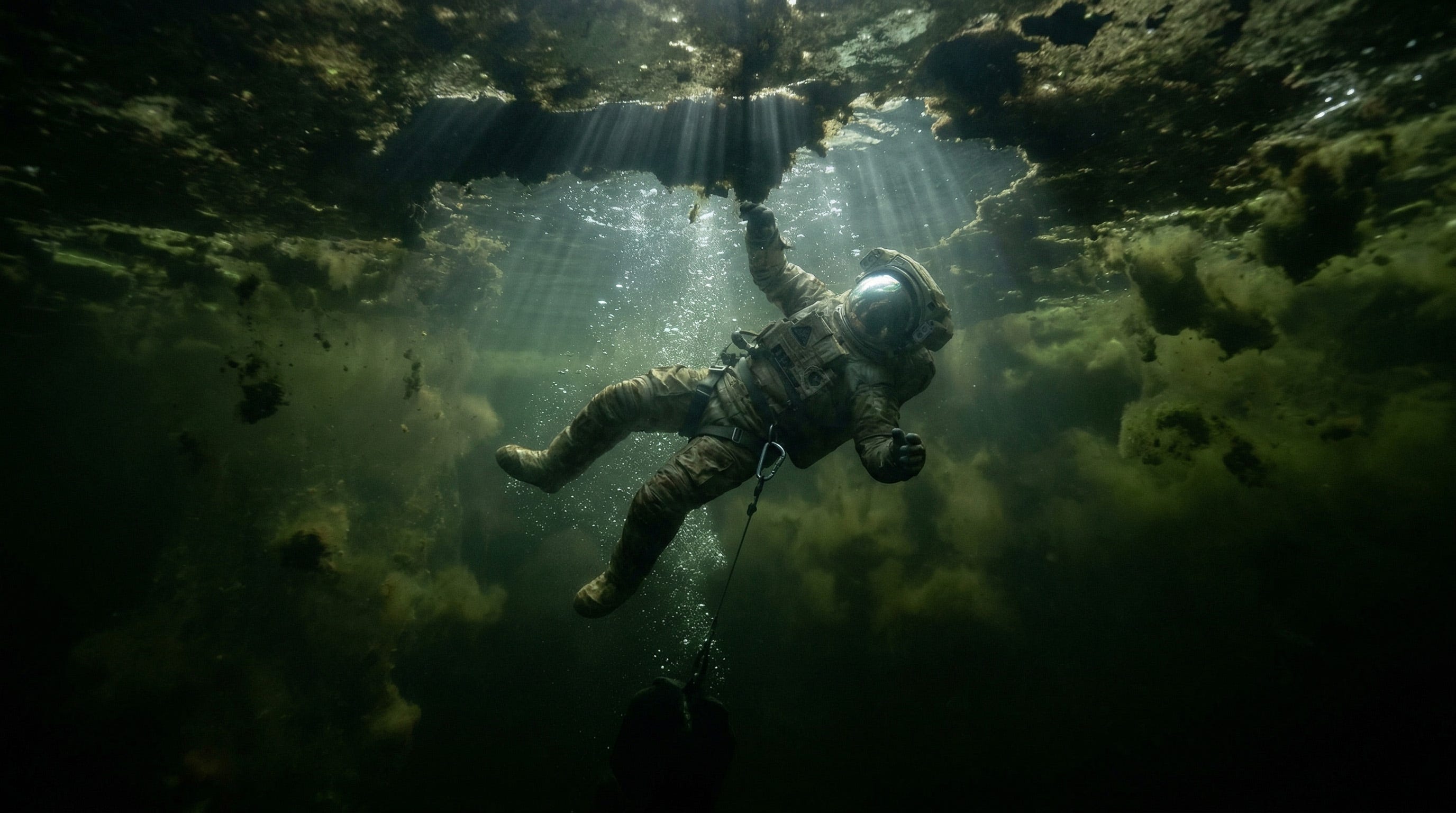
Clawing at the bank of the lake, the Nomad felt the carabiner about his waist tension again. Upon striking the shore, the filtration pump bounced, arcing through the air in a moment of dreaded silence before splashing into the lake. Rent from the shore, tethered by the waist, the Nomad was dragged after it, plunging into the gungy waters of the algal lake. The viscous body of water swallowed the Nomad whole and he was enveloped suddenly by darkness. The thick layer of scum coating the water’s surface sealed shut, blocking out any remnants of the sullen daylight above.
The Nomad was sinking fast, weighed down by the cumbersome pump still attached to his harness. Instinctually, he fought against the anchor, swimming with all the force he could muster in a desperate attempt to break the surface again, but even without the pump, the weight of his EVA suit alone would have made swimming difficult. He continued to sink through the murky waters, the algae soaking away all but the faintest light from the surface. He was panicking, rasping for air, sweating profusely. His heart drummed between his ears at what seemed a thousand beats per minute.
The Nomad swallowed several lungfuls of air and pressed his eyes tightly closed as he took a moment to calm himself. He reached for his harness and fumbled for the carabiner, but it was a triple lock system, and with the current tension applied to it he couldn’t unfasten it… not until he reached the lakebed.
Sucking in several more deliberate breaths, the Nomad waited as he continued to sink. After what seemed an eternity, the filter pump came to rest on the lake floor and the Nomad beside it. The tension released and the Nomad fumbled once again at the carabiner. This time, through great difficulty, he was able to unclip himself from the cable. He was neutrally buoyant, and though the EVA suit was constricting, the Nomad was able to kick with his boots and pull with his gloved hands, beginning the climb through the murky lake back towards the surface.
He barely made it ten metres upwards before he was snagged once again. The winch cable had managed to coil itself around the Nomad whilst he was sliding down the hillside. Now it was knotted tightly around his ankle. He was still anchored to the lakebed, unable to ascend any further. The Nomad panicked again, scrabbling at his heel in an attempt to free his foot from the coils, but the wire had choked itself tightly around his ankle, and he lacked the dexterity whilst wearing his EVA gloves to untangle himself.
Anxiety continued to overwhelm him. His heart spasmed violently in his chest and his lungs constricted in terror. A buzzer sounded inside his helmet and a dreaded alert flashed up across his visor:
Warning! Oxygen Levels Low!
All his panicking and gasping in fear had squandered the air in his tanks. If he continued to hyperventilate, he would have barely two minutes of breathable air left.
Fighting the innate drive to swallow as much air as he could, the Nomad exhaled for as long as possible before inhaling deeply. For the next minute, this was all he did. He inhaled and exhaled. Inhale. Exhale. Inhale. Exhale. His throbbing pulse steadied and his mind was brought back into clarity. Without physically checking, he sifted through his mind to recall all of the tools currently stowed in his EVA harness. Out of everything he took with him whilst carrying out EVAs, he knew that there must be one that could help him now. His plasma cutter! That could save him.
Remembering exactly where the tool was holstered, the Nomad calmly reached for the rear loop on his belt and drew the cutter. Flicking off the safety with his thumb, the Nomad primed the device and pulled the trigger. A white-hot glow illuminated in the murky depths and a sudden jet of bubbles frothed upwards. Calmly allowing himself to sink for a moment, the Nomad released the tension from the wire and lowered the flame down towards the line. The torch melted through the wire in a matter of seconds, and suddenly, the Nomad was free of his anchor. Switching off the plasma cutter, the Nomad stowed it back in his belt, and once again, began to swim upwards.
He kicked and pulled with all his might through the viscous water, all the while watching the counter tick down on his remaining oxygen supply. Suddenly, he broke through the grimy surface. Thrashing about helplessly in the waves, he swivelled to get his bearings. He wasn’t far from the shore, and in a few strokes, he had fought his way over to shallower waters. He managed to stand, despite his exhaustion, and waded out the last few metres before collapsing on the bank.
Rain clattered loudly against his helmet as the Nomad wheezed in exertion. His muscles were screaming, his head throbbing dazedly. The alarm on the inside of his helmet wailed with ever greater urgency, his final air reserves dwindling. He could barely move; but he had no choice. If he did not make it back up the slope in the next minute, he would suffocate there in the mud, on this lonely and sullen world.
Can’t wait for Chapter 8? I’ll be back on Thursday. If you’re enjoying the journey, consider sharing this with a fellow Sci-Fi fan.
Author Commentary
Believe it or not, the lead-up to the Nomad’s accident in this chapter was birthed from real-world experience. For the past decade, my day job has been working as a landscaper. Over the years, I have worked in some pretty miserable weather conditions. The one thing that makes everything harder is mud. On numerous occasions, I have found myself bogged down in conditions that I imagine resemble the infamous mud of the Somme.
Clay and mud when continually trafficked and trampled, under the unrelenting winter rainfall of the Southwest of England, can quickly turn into a hellish quagmire. Moving around becomes exhausting, and in the right (or wrong) conditions, mud reaches an inescapable consistency that coats everything, sucks your boots into the ground, and refuses to let go.
One job that sticks in my mind from years back was building a dry-stone wall atop a steep bank in January. Roughly a dozen tonnes of slate needed to be carted up to the top of the slope by hand. But the ground underfoot was quickly turning to sludge, and the mud was proving increasingly difficult to ascend unaided. The solution was a capstan winch utilised to heave a cart of stone up the bank
Whilst lightning never struck our winch, sending me plummeting down the bank to the bottom, I did experience a few slides through the mud, and lost a few large chunks of slate that went toppling down towards the road below, seeding the inspiration that led to this sequence for the Nomad.
Prefer to binge the whole thing in one go? You can grab the full ebook on Amazon here: