New to the journey through the infinite void? Start here at Chapter 1
See the full Archive here
Ten
The Nomad dropped out of FTL and began his decelerating approach to a class M4 red dwarf. The long burn of his pulsejets gradually slowed him to orbital speeds on the periphery of the system. The dim glow of the small crimson star shone in the remote distance, barely distinguishable against the constellations in the galactic backdrop.
A low-power warning flashed across the Fighter’s display. The Nomad pivoted the ship, using a short burn to navigate into a closer orbit, where the light intensity was great enough to charge the cells. Optimally angling the craft for photon capture, the Nomad unfolded the photovoltaic cells and waited for the ship to recharge. Awaking a while later to find the incomplete array of cells at full capacity, he retracted the panels and powered up the ship’s scientific equipment. After a time, the scan results pinged across the holographic display. The Nomad redeployed the photovoltaic cells to top up on power reserves and began sifting through the data projected before him.
The system was somewhat unremarkable. The star was twinned with a brown dwarf companion orbiting roughly twenty astronomical units out; in possession of a large magnetosphere, the failed star would be ideal for antimatter harvesting. Two small terrestrial worlds in close synchronous orbit were tidally locked to the star, and a belt of comets and asteroids encircled the outer reaches of the ecliptic. It was a barren and unpromising ancient solar system, akin to the vast majority to which the Nomad had journeyed in the years since the catastrophic loss of half his power cells. But as ever, the Nomad made do.
Scrolling through the last pieces of data, he was readying to close the results of the scans, when something leapt out at him: an anomaly. Something inconsistent with the rest of the solar system drifted out in the far reaches of the asteroid field. The Nomad quickly studied the readout, checking and double-checking to ensure it wasn’t a mere artefact in the scans. It was conclusive. An abnormality of significant size was floating on the fringes of the forsaken solar system. If the Nomad was correct in his guess, it was a wreck, and a large one at that.
There was nothing the Nomad could feasibly conceive of that he would ever find a drift in the endless void more valuable than a shipwreck. True, the carcass might already have been picked clean by scavengers, but equally, wreckage in such an inconsequential system as this one might have gone unnoticed for millennia. It could contain anything: valuable elements and resources, fuel tanks brimming with unsiphoned antimatter, oxygen, hydrogen, water, perhaps even useful equipment. But the Nomad knew above all what he hoped to find: power cells. Summoning his sense of cynicism that prevented disappointment, he suppressed his excitement and adjusted the Fighter’s orbit to carry him out into the asteroid field.
The Fighter coasted in a wide swinging orbit towards the outer reaches of the ecliptic. The dim red star receded to a pinprick of light as the Nomad approached the cloud of residual rock and ice left over from the formation of the solar system. Upon approach to the expansive asteroid belt, the Nomad swivelled the Fighter rearward and slowed the craft with a series of short bursts from the pulsejets. Rotating the ship back around, the Nomad powered up the Fighter’s radar array and flight computer, allowing the ship to begin mapping the location and distances of the vast sea of rock adrift in the void.
In their thousands, the asteroids were plotted into the flight computer, their locations highlighted across the Fighter’s HUD, revealing countless floating islands hidden in the inky blackness. Using the RCS for a translational manoeuvre, the Nomad dipped clear of a stone goliath as it loomed dimly from out of the darkness. Another lateral shift moved the Fighter’s flight path clear of the next rapidly approaching iceberg, the gargantuan mass of frozen volatiles tumbling slowly on its axis. The Nomad powered up the ship’s compositional scanners, hoping to identify the wreckage by its differing makeup to the surrounding asteroids. On a whim, he likewise transferred power to the Fighter’s communication scanners. The Nomad never expected to detect any form of signal, he had long ago accepted that he was alone in the crippling infinitude of space, yet within moments of toggling the scanner, his instruments lit up with a returning ping that sounded at regular intervals.
It was no broadcast or SOS, but it was a signal nonetheless; a transponder had activated upon detection of the interrogating signals emitted from the Fighter’s scanners. The Nomad was alone; that was unmistakable. The response was merely a faint blip echoing what once was. What was important, however, was that the blip existed. The ping informed the Nomad that the wreck afloat somewhere within the asteroid belt still had power. Power enough to send and receive basic signals. And where there was power, there would likely be power cells.
The Nomad delved deeper into the asteroid field, negotiating the cloud of residual material left over from planetary formation. Carried by the tide of gravity, the islands of rock and ice were endlessly adrift, forever floating on parallel orbits, their paths never diverting, never crossing, the lonely planetoids eternally condemned to float in relative proximity to one another, but never to interact. It was easy to think of an asteroid field as a maelstrom of collisions and impacts, yet these remnants of the early solar system were imprisoned by time.
Rejected by chance, the asteroids were doomed never to aggregate more so than they had done already. They would never collate to form a planet or moon, and save for the occasional unlikely interaction with an elliptically orbiting comet or the like, these fragments of creation were fated to continue eternally on their predestined paths. Shackled in orbit, their only chance of escaping eternity was the death of the parent star to which they were anchored. Yet this red dwarf burned so dimly that it would likely continue to do so for several trillion more years. These asteroids were bound unceasingly to existence with no prospect of change or finality—much like the Nomad.
Pressing such thoughts from his mind, the Nomad restudied the readouts in front of him as he continued to navigate towards the signal. Finally, his scientific instruments began to detect higher ratios of heavy elements in the surrounding debris. The Nomad activated the Fighter’s landing lights. Two broad incandescent beams shone from the nose of the craft. Immediately before the Fighter, several fragments of debris were suddenly illuminated. The flotsam were shards of spaceship hull, that much was apparent from the readouts in front of the Nomad, yet beyond this, they bore no hint as to what lurked deeper in the field. Negotiating his way between the scraps of metal, the Nomad continued to follow the constantly returning transponder, tracing the signal towards its source.
Larger and larger chunks of wreckage drifted passed the Nomad as he piloted deeper in, the scans of each section offering him new snippets of information. Steadily, he began to build up a picture of the carrion he was scavenging for; it was a large ship, that much was clear, of unknown alien origin. The radiation damage to the metal indicated the wreck had met its end several millennia ago, yet from the littering of flotsam spread over such a wide expanse, the craft appeared to have broken up almost entirely.
The mystery continued to unfold as the Nomad sailed past what appeared to be a section of an immense rocket thruster nozzle. An exhaust that large could only belong to a warship, or perhaps an interstellar ark. The next recognisable item of debris was a turret barrel from a main battery; the wreck was definitely a warship, likely a destroyer or dreadnought.
Perhaps then, this system had been the site of an ancient battle between two warring races. But the degree of annihilation seemed excessive, even for the bloodiest of wars. It was more probable that the extensive disintegration of the warship had been due instead to a collision, likely with the asteroid field, and perhaps at relativistic speeds. Yet in order for that to have happened, at least accidentally, the ship must have suffered a catastrophic failure in navigational systems prior to the collision.
Something didn’t add up, and not knowing what exactly perturbed the Nomad. He felt ill at ease, as if he had forgotten something vital, or if some crucial piece of information had escaped his conscious observations. This chain of thought was abruptly ended by a proximity warning that flashed up across the Nomad’s HUD. The largest section of flotsam so far loomed out of the dark as the pinging signal built to a crescendo. An intact portion of the dreadnought’s hull floated lifelessly up ahead, silhouetted against the faint red haze of the dwarf star. The metal carcass revolved slowly around its centre of gravity, steadily revealing the ruptures and shears to the metal. The buckled and bowed hull section was but a fraction of the original ship, yet even still, its dimensions were several orders of magnitude greater than the minuscule Fighter approaching it. Even at his present range, the gargantuan hunk of debris brimmed the Fighter’s canopy, but still a considerable distance away, his landing lights merely scattered into the void ahead, the spread of the beams too great to cast away any of the shadow bathing the wreckage.
The debris was more than likely the aft end of the warship. A thousand dimples and scrapes mottled the armoured surface from where the dreadnought had ploughed through the asteroid cloud, before finally coming to rest as a scattering of flotsam lost in the lonely void. The range of the debris field stretched several astronomical units, the majority of the wreckage contained within the densest region of the asteroid belt. The Nomad knew that scouring the field in the hopes of finding other large sections of debris was pointless. The chances of finding anything remotely salvageable within the sea of ice and stone by coincidence alone were incredibly remote. The only thing that had led him to this specific section was a signal transponder still active after all this time. He had been incredibly lucky. This alone was enough to set the Nomad on edge. Luck was something he no longer believed in. Something was not right. But he could not afford to pass up this opportunity. And so, the Nomad continued.
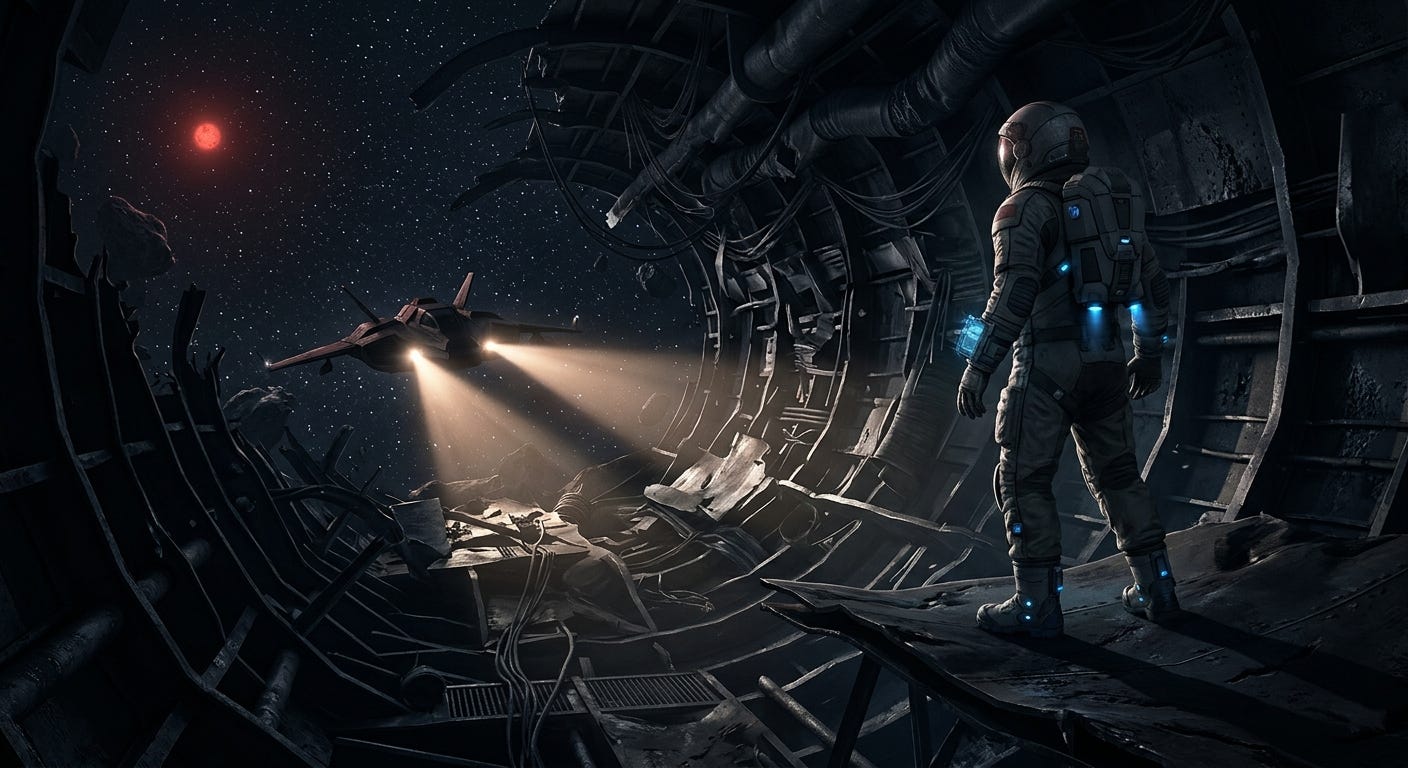
The wreckage loomed larger and larger until the Fighter drifted fully into the debris’s shadow. The mess of scarred and twisted metal had been drastically distorted when the dreadnought came to its violent end, but the ship’s internal structure was still vaguely discernible. Corridors jutted outwards, ending abruptly in jagged edges, whilst rooms hollowed out of the mass of alloy, tunnelling backwards into the shadows. Ventilation and service ducts trailed piping and fraying cables, whilst immense tensile and load-bearing struts extended from the wreckage like a gnarled and mangled skeleton.
The Nomad ran an array of scans on the floating shipwreck, pinpointing the exact location within the crumpled carcass that housed the transponder. It was several compartments deep, inaccessible by the Fighter. Fortunately, the data suggested that the transponder would have its own isolated power source, separate from the main energy cells of the dreadnought that could currently be floating anywhere else in the system.
Reaching beneath his seat, the Nomad pulled out his helmet and locked it over his head. His HUD booted up across the inside of his visor whilst he began shutting down a number of the Fighter’s systems to conserve power. Piloting in as close as possible via the RCS arcjets, the Nomad stabilised his orbit in accordance with the debris, minimising his drift to within a fraction of a metre per hour. The Nomad rotated the cockpit’s safety valve and pressed a series of buttons across the control panel. The gasses of the cockpit hissed as they were rapidly sucked away. The pressure dropped steadily and the beeping transponder faded to quietude as the Nomad was plunged into a vacuum.
The eerie stillness of empty space had always haunted the Nomad. As he retracted the canopy of the Fighter, he was gradually exposed to the raw, dangerous void that constituted the majority of the universe. All that now laid between the Nomad and death was an EVA suit barely a few millimetres thick: a thin layer of compression fabric to protect against the effects of the vacuum, insulated against radiation heat loss, which was then coated in an equally thin reflective weave to ward off ionising cosmic radiation, topped finally by the thickest layer of the suit: an impact resistant material for guarding against micrometeorites.
The Nomad unbuckled himself from the harness of his pilot’s seat, and easing upwards, drifted gently out of the cockpit. On his first spacewalk in recent memory, the Nomad took a moment to fully acclimatise himself with the sensation of weightlessness that was never truly experienced whilst strapped into the pilot’s seat. Acquainted with the microgravity, he activated his EVA suit’s mobility thrusters via the holographic interface on his wrist.
A stream of charged ions expelled from nozzles located on the undersides of his boots, elbows, and back, gently accelerating the Nomad forwards. The propulsion felt cumbersome at first, but the Nomad quickly refamiliarised himself with the thruster control scheme as he negotiated his way over towards a jagged shelf extending from the wreckage. Clasping hold of a warped rung, the Nomad heaved himself inwards and planted his boots down onto the metal ledge. The boots, sensing a ferromagnetic alloy beneath their soles, automatically magnetised, attaching firmly against the metal and locking the Nomad on his feet. This, too was a strange sensation, as there was no sense of weight in his attachment to the floor. Even though he was stood upright, his sense of direction was still lacking an up or a down. Only the very souls of his feet were cemented to the floor; the rest of his body was still free floating.
The experience immediately conjured a traumatic memory of floating in the dark, anchored by his feet to the bottom of a lake, the last vestiges of air ticking away inside his helmet. The haunting flashback summoned a cold sweat across the Nomad’s brow. He stood frozen for a long moment, before pushing the harrowing images back into the deep recesses of his mind from where they had awoken.
Lifting a heel inside his boot and pressing with his toes, the Nomad felt his right foot demagnetise, the suit detecting the shift in pressure beneath his sole, interpreting it as the wearer’s desire to step forwards. His foot floated weightlessly once more and the Nomad clumsily swung it out in front of his body. Then, acting against the natural instinct of allowing gravity to guide his foot back towards the floor, the Nomad actively drove his leg downwards, planting it on the shelf. The boot remagnetised and clamped firmly and flatly to the metal.
A single step was all the Nomad had taken. In his lifetime, he had taken millions. He had been walking since before a time when he even had any memories. A step was the most natural and intuitive movement he could ever conceive of making; it required little effort and thought to carry out. And yet, when something as simple as the force of gravity was removed from the equation, it suddenly became complex. Disorientated and numb from concentration, he focussed on moving forwards one step at a time. It grew easier, as most things do when practised, yet this method of locomotion seemed alien and obtuse.
After a time, the Nomad had travelled some way down the corridor, in towards the heart of the wreckage. He peered back down the tunnel of cold steel to see the Fighter floating motionlessly not too far away. The Nomad required that reassurance. Whenever the Fighter was left unmoored, he needed to at least be able to see it. Had the Nomad made some miscalculation in negating drift, the Fighter could float away without him noticing. It could sail clean out of sight in no time at all if he had made even the slightest mistake when parking alongside the flotsam. He could lose the Fighter altogether, or perhaps worse, have it within sight but just out of range. The mobility thrusters of his EVA suit were simple enough to operate once the Nomad was at ease with them, but their range was limited to a few minutes of usage. If the Fighter drifted too far and too fast, he would never be able to catch up to it. So, every few metres the Nomad trudged down the corridor, he would turn back to check that the Fighter was where he had left it. And sure enough, it was.
Chapter 10 marks the final chapter in this serial available to non-subscribers.
To read Chapter 11, you can join as either a paid or free subscriber.
Alternatively, you can purchase the novel in full now on Amazon!
Author Commentary
A core theme of Flight Through Infinity is the vastness, emptiness, and loneliness of space. The spacewalk in Chapter 10 is the embodiment of these themes. The silence is deafening, and the darkness is absolute. But amidst the emptiness, a mysterious signal beckons the Nomad forward.
Chapter 10 is the start of the novel’s second act and begins after a significant time jump from the previous chapter. I wanted it to be up to the reader to decide just how long had passed since the events on the primordial world, but it is safe to say that it should be measured not in weeks or months, but in years.
Prefer to binge the whole thing in one go? You can grab the full ebook on Amazon here: